| |
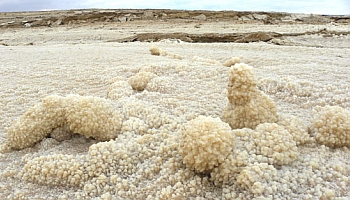
...salt flats left by the receding Salt Sea of Israel
|
the Salt Of The Earth series
Salt Of The Earth
by haRold Smith
a citizen of the Commonwealth (Ephesians 2:19)
"You are the salt of the earth;
but if the salt loses its flavor,
how shall it be seasoned? It is then good for nothing but to be thrown out and trampled underfoot by men." Matthew 5:13
The main source of salt in the region of Israel was the area of the Salt Sea (popularly known as the Dead Sea), especially the massive, about seven miles long, salt cliffs of Jebel Usdum (Mount Sodom). The face of the ridge is constantly changing as weather interacts with the rock salt.
Ezekiel 47:11 ((click on highlighted words to view content)
highlights the importance of the Salt Sea's salt. The Hebrew people harvested salt by pouring sea water into pits and letting the water evaporate until only salt was left. They used the mineral for seasoning and as a preservative. In
2Chronicles 13:5
King Abijah referred to YaHoVeH's covenant promise to David that he will not lack a man to seat on Israel's throne as a
Salt Covenant
- that is a covenant that can never be broken. Since genuine salt, by itself, can never lose its flavor as its chemical properties do not change, this saying in Matthew becomes difficult to understand. A saying in the Talmud (b. Bekhorot 8b) attributed to R. Joshua ben Chananja (ca. CE 90), when asked the question "When salt loses its flavor, how can it be made salty again?" is said to have replied, "By salting it with the afterbirth of a mule." He was then asked, "Then does the mule (being sterile) bear young?" to which he replied: "Can salt lose its flavor?" The point appears to be that both are impossible. So, what was Yeshua trying to convey - under what circumstances could salt lose its flavor?
Salt is a compound of sodium (Na), an unstable metal that is highly flammable and chloride (Cl), a lethal gas. When salt is exposed to extreme heat, these elements are released - producing an environment that causes heat retention. Those who know their way around cooking techniques know that salt added to water makes the water boil at a higher temperature, thus reducing cooking time. The background of the saying Yeshua referred to above points to the use by mid-east bakers of the time to line the floor of their ovens with salt blocks to make the fire hotter. Under the intense heat of the oven fire, these blocks would eventually crystallize and undergo a change in chemical composition, finally becoming unusable. At that point, they would be crushed and thrown out with their only usefulness defined as a covering for the roadways that were heavily walked upon. This verse comes immediately on the heels of the
Sermon on the Mount
(often referred to as the Beatitudes) that begins with the chapter in
Matthew 5
where Yeshua describes the makeup of spirit, the "chemical composition" if you will, of those who long for the Spirit of the Father.
|
"I indeed baptize you with water unto repentance, but He who is coming after me is mightier than I, whose sandals I am not worthy to carry.
He will baptize you with Spirit and fire." Matthew 3:11
|
| |
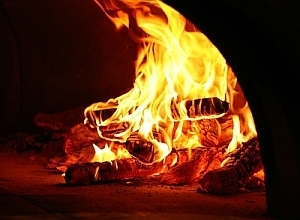
...the crucible of fire
|
Salt has no choice in how it reacts to extremes -
we do.
Yeshua is saying to not allow our spirit composition to change when we find ourselves in the middle of extreme circumstances. Just as it is possible for salt to lose its flavor by having its core nature changed in the intense heat of fire, the only place where those who have embraced the Nature of Spirit can lose their flavor is also in the fire. What sets us apart from salt is that, as those embracing the Nature of the One True Elohim of Israel (notice that He was speaking to His disciples - not the multitude as has been portrayed in various circles), we have the ability to choose how we respond while in the fire. Yeshua is saying to not allow our composition to change when we find ourselves in the middle of extreme circumstances. If we choose to be humble and meek in the face of pride and hatred, if we choose to remain pure in the face of evil, if we choose to make peace in the face of contention and if we hunger and thirst for His righteousness in the middle of all that is calling for our attention otherwise; then we are manifesting the true Nature of YaHoVeH - exemplified by the Risen One who lives within those who embrace
His Words.
The Greek word translated as the English
power
used in John 1:12 is
exousia,
the same word which is used for the translated word authority in
Luke 9:1
and means - power of choice. It is only those who exercise their '"power of choice" (meaning the choice given them to exercise their belief in the Name of YaHoVeH) that become sons of YaHoVeH. The authority of choice we are given is the power to choose to exhibit our faith, our belief in His Words to be Truth in the face of obstacles that are, seemingly, overwhelming. Every one of the Beatitudes listed describes how the external should be responded to from
within.
The last involves persecution. It is amusing to think that when true persecution comes, people believe those qualities listed in the Beatitudes will somehow miraculously just rise from within to be exhibited toward perfect strangers when they have yet to be exercised toward those whom we love and are in the closest proximity to us right now.
|
"Beloved, do not think it strange concerning
the fiery trial
which is to try you, as though some strange thing happened to you; but rejoice to the extent that you partake of Messiah's sufferings, that when His glory is revealed, you may also be glad with exceeding joy." I Peter 4:12-13.
|

|
...purified seven times
|
A friend of mine became involved in the ancient art of blacksmithing a while back. I watched him fashion a piece of metal that he was making into a sword. Beginning with this ugly bar of raw steel, he pumped the bellows on the coals in the fire pit until they became white hot, after which he plunged this metal bar deep in between the recesses of the coals. He continued pumping on the bellows. Once the ingot had become as white as the coals, he grabbed the protruding end with some large tongs, laid it on an anvil and began to pound it mercilessly with a hand-held sledge hammer until the heat had obviously receded from it. He then plunged the misshaped metal bar into a bucket of water that was on the floor and left it hissing there for a few minutes until it had sufficiently cooled. Grabbing the steel bar once again, he informed me that to temper steel (one of the hardest substances known to man) it must go through this entire process I had just witnessed at least seven times. Once it was finished, polished and sharpened, this ugly piece of metal was transformed into a beautiful sword - an immaculate piece of craftsmanship. As I watched it being forced into the fire again and again this day, however, with its shape noticeably refined and sculpted each time it emerged, I could not help but to be reminded of the admonition of the apostle Peter above.
Hebrews 5:8
says that Yeshua, our example, learned obedience to the Father by the things which he suffered. Our natural, human inclination is to recoil from the heat of the fire because it is not pleasant and is uncomfortable; but, in so doing, we extract ourselves from the very process used to fashion us, to shape us and to mold us into His image. It is in the extremes that we learn of His nature. If we choose to exhibit His nature in the extremes then
the power of Spirit
is unleashed within us to temper us to withstand and, in the midst of the fire, to be a "sweet smelling" flavor to the rest of the world.

|
Salt of the Earth - a discussion

|
"For we are unto Elohim
a sweet savour
of Messiah, both among those being saved and among those being lost..."
2Corinthians 2:15
|
the Salt of the Earth series
Part One - Salt of the Earth
Part Two - Seasoning
Part Three - the Tithe
Part Four - Faith or Fear?
|
 ???Questions???
Please feel free to email me at harold@hethathasanear.com.
While not claiming to have all
the answers, it would be an honor to partake with you of what Spirit is uncovering.
CLICK HERE TO RETURN TO HOME PAGE
|